
How to Identify Bar-headed Goose Feathers
How to identify Bar-headed Goose feathers by the two black bars crossing an otherwise white head, the black neck stripe, and overall pale grey body tone.
Read the full Bar-headed Goose encyclopedia entry →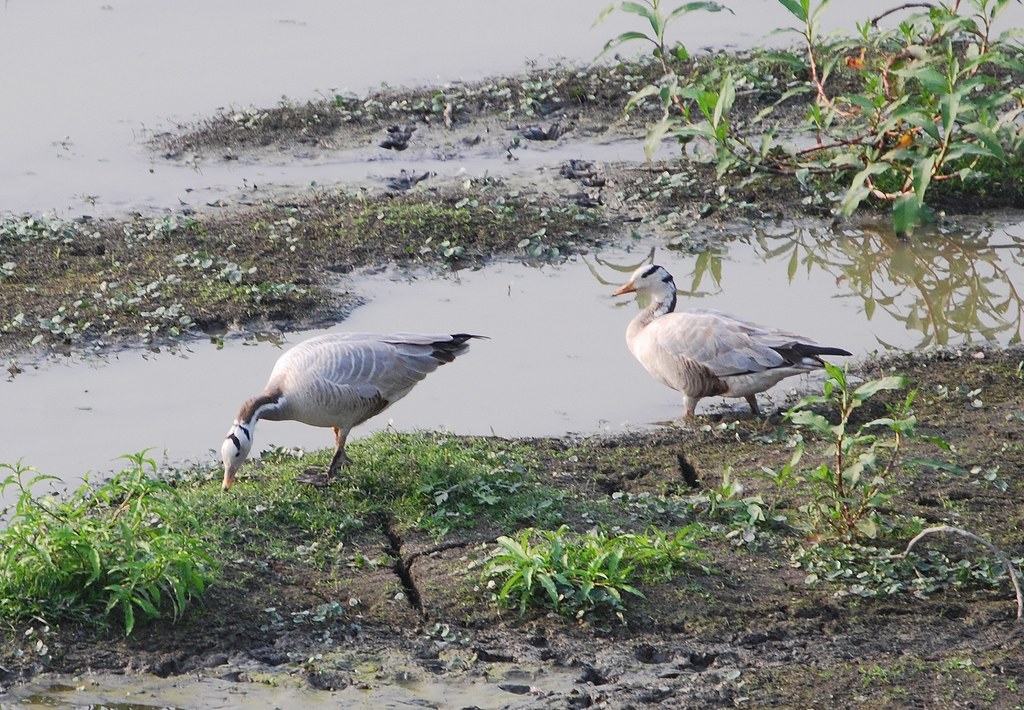
What Bar-headed Goose Feathers Look Like
The Bar-headed Goose is famous for its high-altitude migrations over the Himalayas, and its feathers show a clean, pale pattern well suited to a bird that spends much of its life in bright, open, high-elevation habitats. Body feathers are an overall pale grey to white, notably lighter than most grey geese, giving a washed-out, silvery look rather than the warmer brown tones of species like Greylag Goose. The head is mostly white, crossed by two black bars running across the back of the crown and nape - a genuinely unique pattern among geese and highly diagnostic if you find a head feather showing part of one of these bars. A black stripe also runs down the back of the neck, so a nape or neck feather may show a clean black stripe against the white background. Flight feathers are grey with darker tips.
Step-by-Step: Is This Feather From a Bar-headed Goose?
- Look for a black bar on white. Any head feather showing a crisp black band against an otherwise white background is a near-certain match for this species among geese.
- Check the neck for a black stripe. A feather from the nape showing a solid black line down an otherwise white surface fits this species' distinctive neck stripe.
- Confirm pale grey body tone. Body feathers notably paler and cooler-toned than typical farmyard or Canada Goose feathers support this identification.
- Measure the feather. Primaries in the 20-25 cm range fit a mid-sized goose, smaller than a swan but larger than a duck.
- Weigh the location and season. A matching feather found in South or Central Asia, particularly near high-altitude lakes or wintering wetlands in the Indian subcontinent, strongly supports this species.
Similar Species & How to Tell Them Apart
- Greylag Goose: Warmer brown-grey body tone without any black head bars, and an all-white or plain head rather than the barred pattern.
- Snow Goose: All-white body (in white morph) without any black head markings, and found in a completely different range (the Americas) rather than Asia.
- Domestic/farmyard geese: Highly variable but almost never show the specific double black head bar pattern unique to this species.
- Swan Goose: Shows a brown cap and stripe down the foreneck rather than the Bar-headed Goose's white head with black cross-bars.
Where & When You'll Find Them
Bar-headed Geese breed on high-altitude lakes across Central Asia, including the Tibetan Plateau, and undertake one of the most extreme migrations of any bird, crossing the Himalayas to winter on lowland wetlands and farmland across the Indian subcontinent. Feathers on the breeding grounds are most likely found around lake margins during the summer breeding and post-breeding molt period, when adults become briefly flightless. On the wintering grounds in South Asia, feathers accumulate around communal roosting wetlands and adjacent farm fields through the winter months until birds depart on their return migration in early spring.
Frequently asked questions
What is the single most diagnostic clue for this species?
A white head feather crossed by a crisp black bar is essentially unique among geese and is the fastest way to confirm this species.
Does the neck have any markings?
Yes - a black stripe runs down the back of the neck, so a nape feather may show a solid black line against the white background.
How pale is the body compared to other geese?
Body feathers are notably pale grey to white, cooler and lighter than the warmer brown-grey of Greylag Goose or similar species.
Could this be a Snow Goose feather instead?
Snow Goose lacks any black head markings and occurs only in the Americas, so range and the absence of head bars rule it out.
When and where would I find this feather?
Near high-altitude breeding lakes in Central Asia during summer molt, or around wintering wetlands and farmland across the Indian subcontinent in winter.