
How to Identify Australian Pelican Feathers
A field guide to spotting Australian Pelican feathers by their huge size, blackish-brown flight feathers, pure white powder-down body feathers, and where colonial roosts leave the biggest concentrations.
Read the full Australian Pelican encyclopedia entry →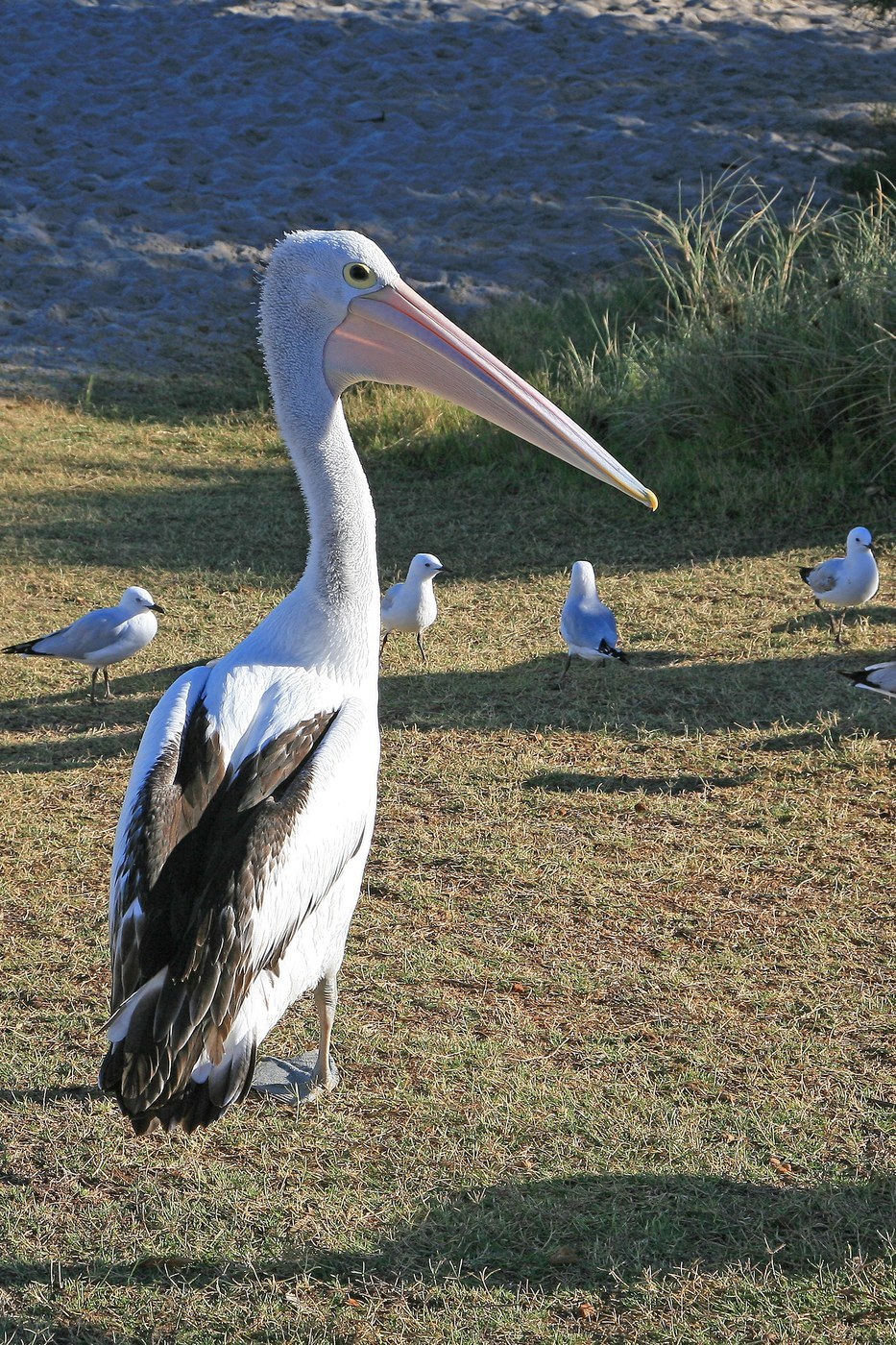
What Australian Pelican Feathers Look Like
Australian Pelicans are enormous waterbirds, and their feathers match: this species produces some of the largest feathers you're likely to find on any Australian shoreline. Primaries can reach 40-45 cm long, with thick, pale rachises (shafts) that are almost rod-like compared to a songbird's flimsy quill. Flight feathers - primaries and secondaries - are blackish-brown with a slight gloss, contrasting sharply with the rest of the plumage. Body (contour) feathers are pure white, often with a faint peachy or apricot blush during the breeding season, and they have a dense, plush texture because pelicans grow specialized powder-down feathers that crumble into a fine waterproofing dust - if you rub a body feather and see chalky white powder come off, that's a strong pelican clue. Tail feathers are short, stiff, and blackish-brown, more like paddles than the tapered rectrices of a raptor.
Step-by-Step: Is This Feather From an Australian Pelican?
- Measure it. Anything over 30 cm found near water in Australia is worth checking against pelican; body feathers are smaller (8-15 cm) but unusually broad and downy at the base.
- Check the color split. Pelican feathers are almost never patterned - they're either solidly blackish-brown (flight feathers) or solidly white (body feathers), with little mottling.
- Look at the shaft. Pelican rachises are thick, pale, and rigid; a small piece should feel stiffer than a gull or duck feather of similar length.
- Rub the barbs. If a chalky white residue comes off on your fingers, that's powder down, which pelicans (and herons) produce in abundance.
- Consider the find site. Pelicans loaf and roost communally on jetties, sandbars, and lake edges, so feathers turn up in clusters rather than singly.
Similar Species & How to Tell Them Apart
- Australasian Gannet: Also white-bodied with black flight feathers, but gannet feathers are noticeably smaller, stiffer, and more pointed, and gannets favour coastal/pelagic waters rather than lake and river edges.
- Black Swan: Produces mostly black body feathers with white flight feathers - essentially the reverse color pattern of the pelican, which is the quickest way to rule it out.
- Cormorants (e.g., Little Black Cormorant): All-dark feathers with a green-black sheen; lack the pelican's pure white body feathers entirely.
- Silver Gull: Much smaller feathers overall and grey-toned rather than blackish-brown flight feathers.
Where & When You'll Find Them
Australian Pelicans favour large lakes, estuaries, sewage ponds, and slow rivers across most of Australia, often gathering in large, conspicuous flocks. Because they are colonial breeders, feathers accumulate heavily around nesting islands and communal loafing sites during and after the breeding season, which varies regionally but often follows rain-driven flooding of inland lakes. Wing molt in pelicans is gradual rather than a single flightless event, so flight feathers can be found scattered through much of the year, while body feathers - especially the powder-down type - are shed more continuously and pile up wherever the birds preen and roost.
Frequently asked questions
How big are Australian Pelican feathers?
Primaries can reach 40-45 cm, among the largest feathers of any Australian bird, with thick, rigid, pale shafts.
Why does my white feather have chalky powder on it?
Pelicans grow powder-down feathers that crumble into a fine waterproofing dust; rub the barbs and check for a chalky white residue as a strong pelican clue.
What colors should I expect on a pelican feather?
Body feathers are solid white and flight feathers are blackish-brown with a slight gloss - pelicans rarely show mottled or patterned feathers.
Could this actually be a gannet or swan feather?
Gannet feathers are smaller and stiffer; Black Swan shows the reverse pattern (black body, white flight feathers), so checking size and which parts are black versus white quickly rules these out.
When are pelican feathers easiest to find?
Look around communal roosts, jetties, and breeding colonies during and after the breeding season, when molt and everyday preening losses concentrate feathers in one place.
Australian Pelican identified by the community
Recent Australian Pelican feathers identified with Feather Identifier.

