
How to Identify Amethyst Sunbird Feathers
A guide to the iridescent violet throat and crown feathers that give the Amethyst Sunbird its name, and how they compare to other African sunbirds.
Read the full Amethyst Sunbird encyclopedia entry →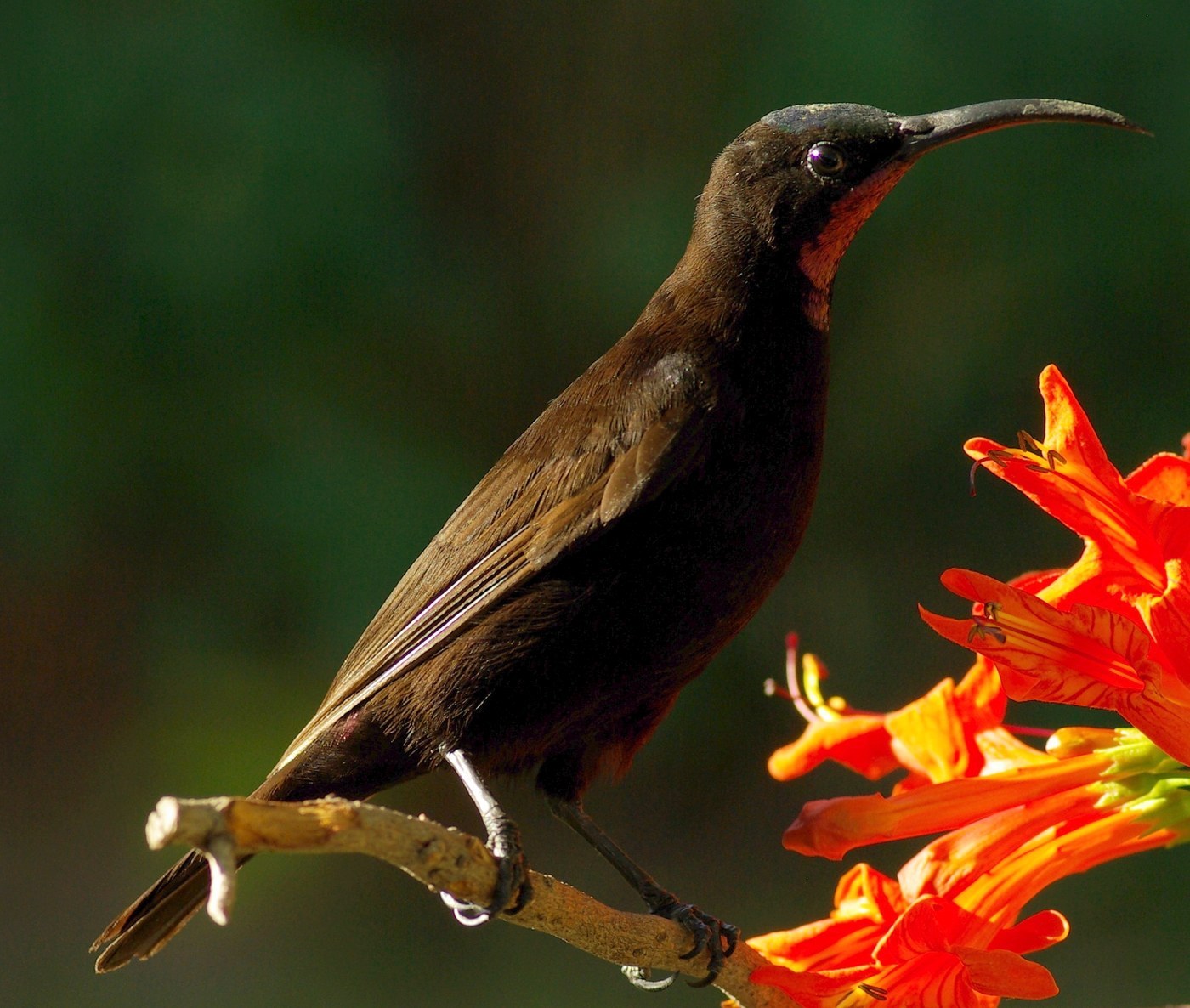
What Amethyst Sunbird's Feathers Look Like
Male Amethyst Sunbird feathers rely on structural iridescence rather than pigment, so their appearance changes dramatically with lighting. In direct light, throat and crown feathers flash a brilliant amethyst-violet to deep purple, but in shade or at certain angles the same feathers can look almost flat black — a defining trait of structurally colored feathers. The rest of the body plumage is a dark olive-brown to blackish-brown, providing a subdued backdrop to the flashy throat patch. Some individuals show a small iridescent patch of metallic green or blue at the shoulder (lesser coverts), adding a second flash color in the right light. Female Amethyst Sunbirds lack iridescence almost entirely — their feathers are a plain dull olive-brown above and paler grayish-buff below, with at most faint, dusky mottling on the throat, making them far less conspicuous than males. Feathers overall are small and fine, typical of a sunbird, with flight feathers only around 4–5 cm.
Step-by-Step: Is This Feather From an Amethyst Sunbird?
- Check for color-shifting iridescence. A feather that looks black in one light but flashes violet-purple in another strongly suggests this species' throat or crown.
- Look for a small green/blue shoulder patch. An iridescent patch distinct from the violet throat can accompany the identification in some males.
- Consider dull olive-brown feathers as a possible female. Plain, non-iridescent olive-brown body feathers with pale grayish-buff underparts fit a female or immature.
- Judge size. Small flight feathers around 4–5 cm fit a sunbird rather than a larger passerine.
- Rule out true iridescent green species. If the flash color is green or bronze rather than violet, consider a different sunbird species (see below).
Similar Species & How to Tell Them Apart
The Scarlet-chested Sunbird, found in overlapping range, shows a scarlet-red throat patch, not violet, along with a dark, speckled belly — an easy color-based separation from Amethyst Sunbird's purple throat. Malachite and Bronze Sunbirds flash iridescent green on the head and body rather than violet, so any feather with a green (not purple) sheen points to one of those species instead. The Black Sunbird and other plain dark sunbirds lack strong iridescence altogether, appearing a flat sooty black in all lighting rather than shifting to violet — the presence of any violet flash is the clearest way to confirm Amethyst Sunbird specifically among Africa's many iridescent nectar-feeding birds.
Where & When You'll Find Them
Amethyst Sunbirds are found across a broad swath of sub-Saharan Africa, in woodlands, savanna, gardens, and forest edges, wherever flowering trees and shrubs provide nectar. Many populations are largely resident, though some undertake local movements tracking flowering seasons. Feathers are most likely to be found near favored flowering trees and shrubs used for feeding, and molt timing varies regionally but often follows the end of the local breeding season, which is tied to rainfall patterns rather than a fixed calendar month across the species' wide range.
Frequently asked questions
Why does the same sunbird feather look different colors in different photos?
The violet throat color comes from microscopic structural features in the feather rather than pigment, so it flashes bright amethyst-purple in direct light but can look nearly black in shade or from a different angle.
How do I tell this from a Scarlet-chested Sunbird feather?
Scarlet-chested Sunbird shows a red throat patch rather than violet, making the two easy to separate by color whenever the iridescent patch is visible.
Are female Amethyst Sunbird feathers identifiable?
They're much less distinctive since females lack iridescence, showing plain olive-brown upperparts and grayish-buff underparts instead, so a female feather is harder to confirm without more context.
What if the flash color is green instead of violet?
A green iridescent flash suggests a different species, such as Malachite or Bronze Sunbird, rather than Amethyst Sunbird, whose signature color is specifically violet-purple.