
How to Identify Abert's Towhee Feathers
A practical guide to recognizing the plain grayish-brown feathers, black face mask, and cinnamon undertail tones of Abert's Towhee in the desert Southwest.
Read the full Abert's Towhee encyclopedia entry →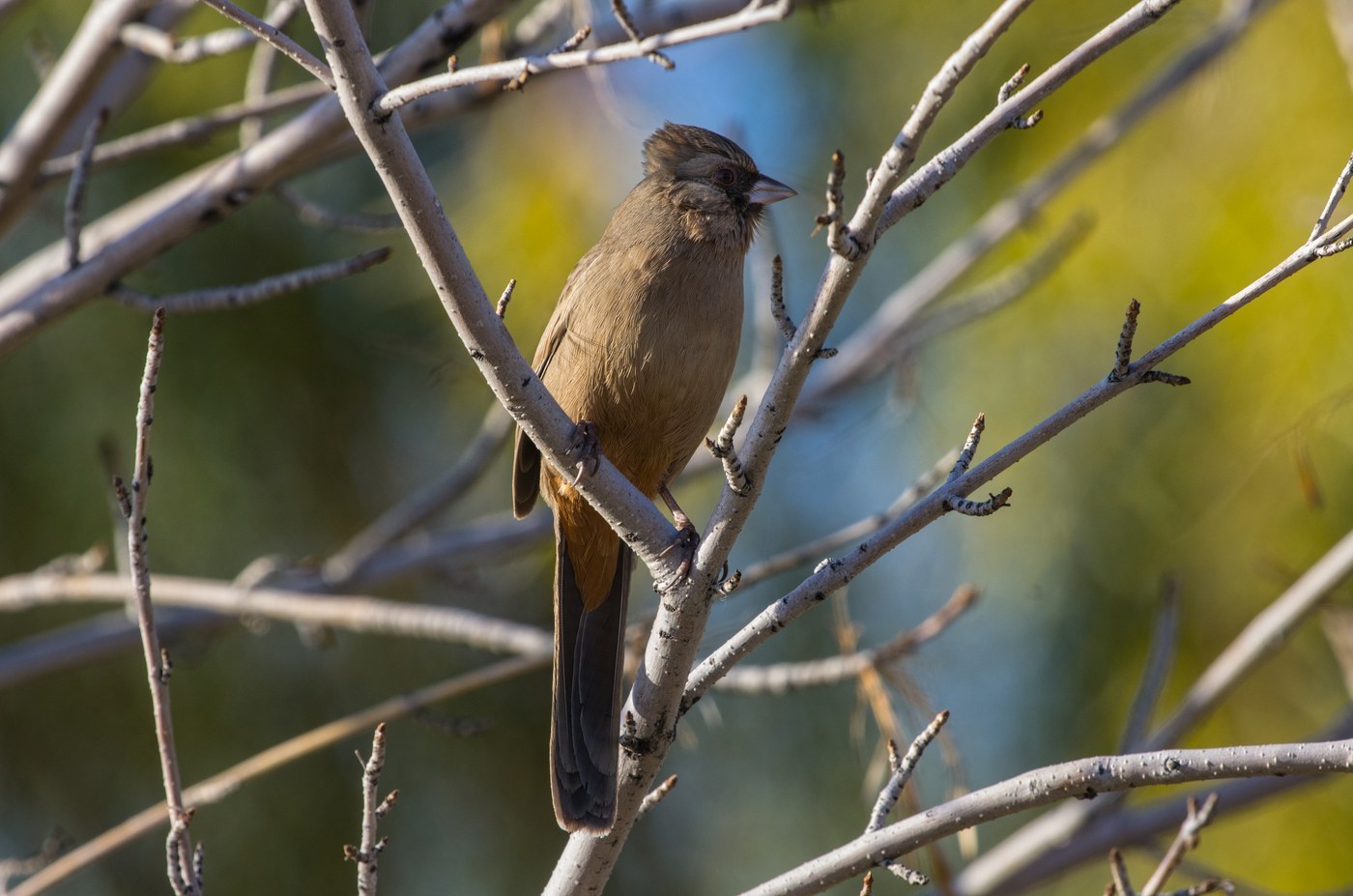
What Abert's Towhee's Feathers Look Like
Abert's Towhee is a large, plain-looking sparrow relative built for skulking through dense desert brush, and its feathers match that low-key lifestyle. Body feathers are uniform grayish-brown to warm sandy-brown with no streaking, spotting, or barring anywhere on the back, wings, or chest — a rare trait that itself is diagnostic once you rule out juveniles. The most useful clue is a small patch of blackish feathers around the face and lores (the area between the eye and bill), which stands out against the otherwise plain brown head. Undertail covert feathers carry a warm cinnamon-buff wash that is noticeably richer than the rest of the body. Flight feathers are plain brown, rounded at the tip, and unmarked — no wing bars, no pale edging. The tail is long and graduated, with broad, rounded, plain brown feathers roughly 10-12 cm long.
Step-by-Step: Is This Feather From a Abert's Towhee?
- Check for total plainness. Reject any feather with obvious streaks, spots, or bars — Abert's Towhee plumage is essentially patternless.
- Look for a small black feather from the face. A tiny blackish feather with no brown at all, found alongside plain brown ones, points to the face mask.
- Check the undertail area. A warm cinnamon-buff feather among otherwise gray-brown ones likely came from the vent or undertail coverts.
- Measure the tail feather. A long (10+ cm), broad, plain brown feather with a rounded tip is consistent with this towhee's graduated tail.
- Feel the texture. Body feathers are soft and thick-based, typical of a ground-foraging sparrow relative, not thin or wispy.
Similar Species & How to Tell Them Apart
- Canyon Towhee: Also plain brown, but lacks the black face mask and instead shows a faint necklace of fine dark streaks across the upper breast; it favors rocky uplands rather than desert riparian washes.
- California Towhee: Nearly identical plain brown tone and no face mask, but ranges barely overlap — California Towhee sticks to coastal and foothill California chaparral, not the Sonoran Desert interior.
- Green-tailed Towhee: Easily ruled out — it has a rufous cap, white throat stripes, and greenish-edged flight feathers, all absent in Abert's Towhee.
Where & When You'll Find Them
Abert's Towhee is a non-migratory resident of dense mesquite bosques, desert washes, and riparian thickets in the Sonoran Desert of Arizona, southeastern California, and northern Mexico. Because it doesn't migrate, feathers can be found year-round near its low, tangled brush habitat, but the heaviest feather drop follows the post-breeding molt in late summer (roughly July through September), when adults replace worn plumage after nesting.
Frequently asked questions
What's the single best clue for identifying an Abert's Towhee feather?
A completely unmarked, plain grayish-brown feather combined with a small blackish feather from the face is the strongest combination, since almost no other desert bird its size is this plain overall.
Could a plain brown feather just be a female House Sparrow or wren?
Those species are smaller and their feathers run 3-6 cm; Abert's Towhee feathers are noticeably larger and thicker-based, matching a bird about 21-23 cm long.
Do juvenile Abert's Towhees show any streaking?
Young birds can show faint, subtle streaking on the underparts that adults lack, so a lightly streaked plain brown feather from desert habitat may still belong to a juvenile of this species.
Are Abert's Towhee feathers ever found far from water?
Rarely — this species is tightly tied to riparian vegetation and mesquite bosques, so feathers found in open, dry desert scrub without nearby washes or streamside brush are less likely to be this species.